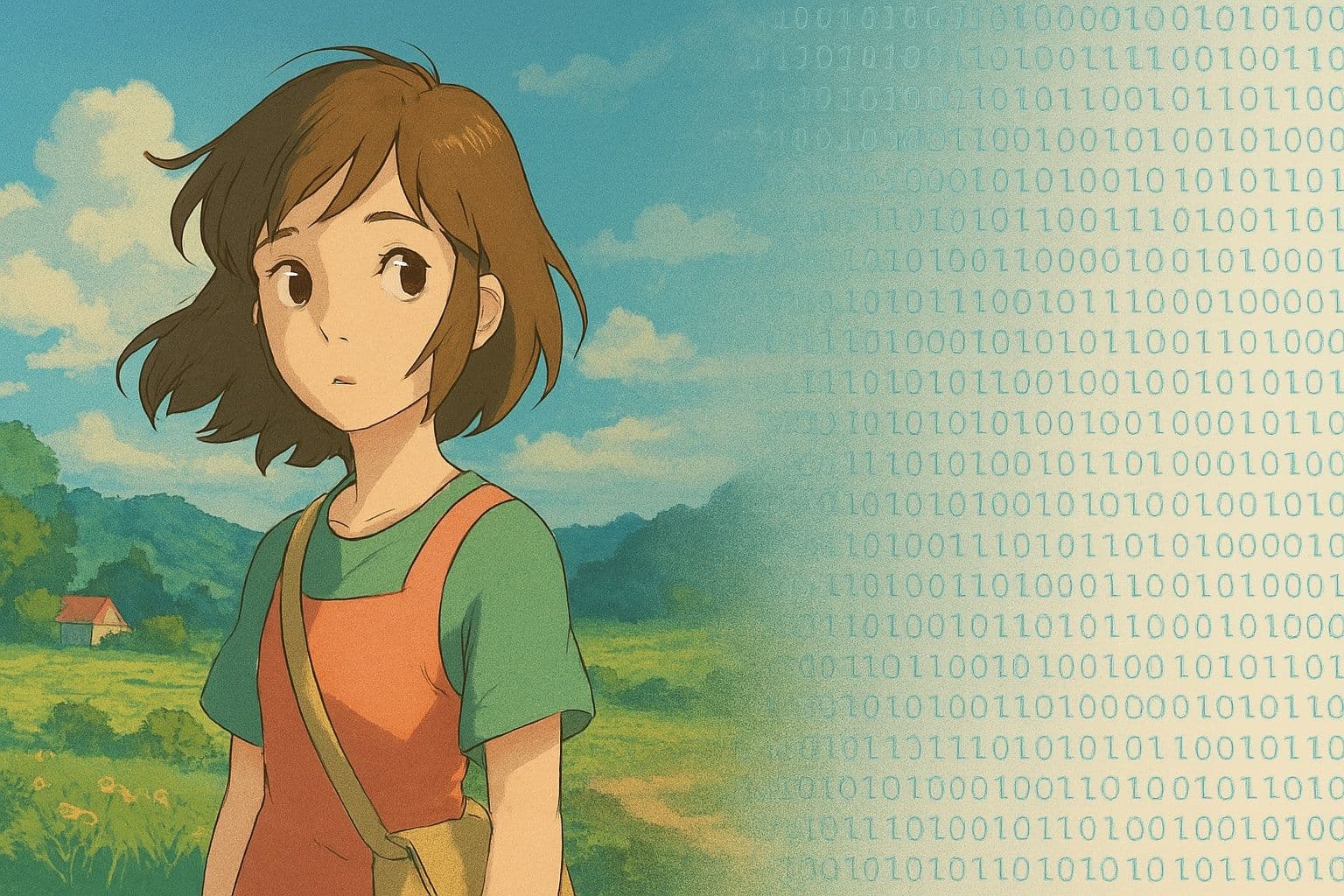
Story without a Voice: AI's Need for Humanity
AI has the power to do anything. Except be a human.
I was 22-years-old the first time I saw a Studio Ghibli film. My college roommate had a job as a movie critic for the city paper, which meant free movies.
I walked into the theater a Southern frat boy wondering why we were watching a Japanese cartoon about a little girl. By the time the credits rolled, I was so moved by Hayao Miyazaki’s Spirited Away, I walked out in tears.
Cut to today:
Ai is being used to recreate iconic Ghibli animation.
Brushstroke by brushstroke, model after model, prompt after prompt—AI is being trained to recreate the visual language of one of the most soulful, intentional and human animation studios of all time.
And people hate it.
Not because the outputs are ugly.
Because they’re empty.
An Artificial Attempt at Humanity
Trained animators are watching as masterpieces are reduced to formulas, created by anyone who can spin a few words together in a free prompt. They’re right to be angry.
As with so much AI-generated content, the robots get the style right, but not the spirit. The pacing’s off. The feeling’s muted. Like watching a cosplay of something that should be sacred. This isn’t the first time capitalists have used AI to replicate an evolved art form in hopes of going viral. And it’s far from the last.
In the rush to adopt AI, businesses are scaling faster than ever—more content, more automation, more voice clones. And yet, AI is being framed not just as a tool, but as a creator. AI can generate faster than you and I ever could. But AI doesn’t create. It recombines.
The Mimicry of AI
AI, for all its promise, has zero new ideas. It just has millions of combinations of what it’s already scraped.
In film school, I studied the classic masterpieces of Scorsese, Kurosawa, Coppola. I spent weeks on a single film trying to understand the rhythm, the structure, the emotional current. That’s what artists do. We study the form to discover meaning, to craft something new that captures emotions.
About 25 different AI-based logo makers swore they could jump start my branding in no time. But in the end, I have my handwriting to a human designer, and that's how Protagonist Ink got its identity. It's a piece of my handwriting. That’s what so many brands, startup, tech ventures and entertainment studios cannot replicate.
To Be or Not to Be
Having AI tell your story is like telling an engineer to recite Hamlet. No scenery, no inflection, no lighting. No context of the one of the cruelest tragedies ever written. Just lines, no life. Try to keep that audience awake—or even in the theater.
If you’re looking for connection through AI, you’re looking in the wrong place. There’s only one place you can find that:
Humanity.
Some people love AI. Some people swear it’s ruining society.
AI has zero opinion on the matter, just like your lawn mower has zero opinion on your grass. It doesn’t care that it cuts—it’s just doing what you tell it. No soul, all goal.
It needs the human to architect resonance. To shape meaning, emotion and connection to tell your human story, like only a human can. Because before long, your audience will feel the difference.
Because at this point, we all know when we're talking to heart, or talking to code.
Your audience does, too.
MORE INK...
Brand Messaging Not Working? It's Probably a Story Structure Problem
Wrong clients, constant explaining, endless rewrites? Here's why brand messaging fails and how to repair the story structure underneath your copy and offers.
Your Story Shapes Your Reality. You Can Change it.
The stories that once kept us safe can later keep us stuck. Here's how to recognize the ones running quietly in the background — and how to rewrite them.
Protagonists Wage Their Own War
Leaders often cast themselves as supporting characters without realizing it. True protagonists own their journey, define their terms, and wage their war.